> ## Documentation Index
> Fetch the complete documentation index at: https://docs.levelblue.com/llms.txt
> Use this file to discover all available pages before exploring further.
# Creating Cisco Secure Endpoint Response Action Rules
You can create orchestration rules in USM Anywhere that automatically trigger a Cisco Secure Endpoint response action when events, alarms, or vulnerabilities match the criteria that you specify. For example, you might create a rule where USM Anywhere automatically triggers an action in your Cisco Secure Endpoint environment when malware is detected so that a member of your response team can manage and address the issue.
After you create a rule, new events, alarms, or vulnerabilities that match the rule conditions will trigger the Cisco Secure Endpoint response action. The rule does not trigger for existing events, alarms, or vulnerabilities.
You can create a new rule as follows:
* **From the Rules page**: The Rules page provides access to all of your orchestration rules. The Orchestration Rules list includes suppression rules, alarm rules, event rules, filtering rules, notification rules, and response action rules. You can create new rules using the specific matching conditions that you define, as well as edit, delete, and enable or disable rules. See [Orchestration Rules](../../user-guide/rules-management/orchestration-rules) for more information about managing orchestration rules.
Go to **Settings > Rules** and select **Response Action Rules** on the left navigation panel. Then click **Create Response Action Rule** to define the new rule.
**To define a new Cisco Secure Endpoint response action rule**
1. Enter a name for the rule.
2. Select the **Sensor**.
3. Select the **App Action** for the rule.
4. At the bottom of the dialog box, set the Rule Condition parameters to specify the criteria for a matching alarm or event to trigger the rule.
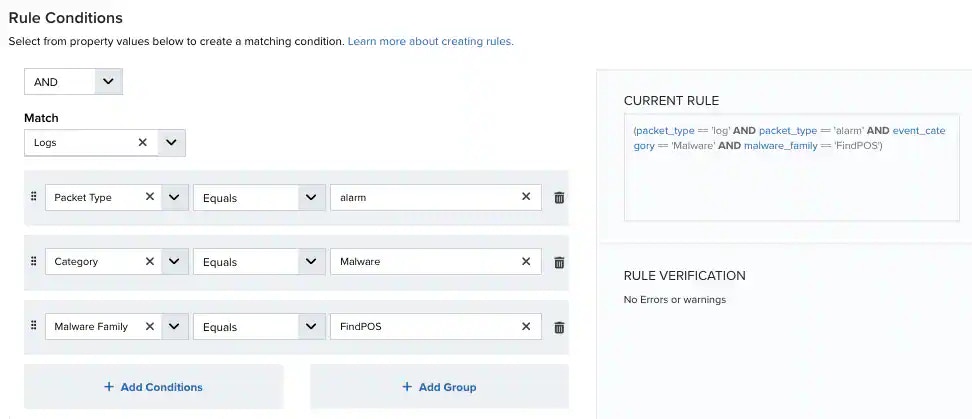 * If you create the rule from an applied action, this section provides suggested property/value pairs from the selected alarm or event that you can use as conditions for the rule. Click the
  icon to delete the items that you do not want to include in the matching conditions. You can also add other conditions that are not suggested.
* If you create the rule from the Rules page, you must use the Add Condition and Add Group functions to define the property/value pairs that you want to use as conditions for the rule.
* At the bottom of the dialog box, click **More** to display the optional multiple occurrence and window length parameters.
Select an operator and add one or more conditions to form the conditional expression. You can include a condition group to evaluate a subset of conditions. The Current Rule pane displays the constructed expression in standard syntax. The box displays a red border if the expression is syntactically invalid as currently specified. A valid expression is required to save the rule definition.
Select the operator used to determine the match for multiple conditions:
* **AND**: Match all conditions.
* **OR**: Match any one condition.
* **AND NOT**: Exclude items matching all conditions after the first.
* **OR NOT**: Include all items that do not match any conditions after the first.
Click **Add Condition** to add a condition. For each condition, specify the field name, evaluator, and value. If the evaluation returns true for the condition, it is a match.
Click **Add Group** to add a condition group. A new group includes a condition and its own operator used to match the conditions within the group. You can nest condition groups.
Specify the number of event or alarm occurrences that produce a match on the conditional expression to trigger the rule. The default value is 1. You can enter the number of occurrences or use the arrow to scroll the value up or down.
USM Anywhere uses this in conjunction with the Length option to specify the number of occurrences within a time period that will trigger the rule. For example, you can define a rule to trigger for an unauthorized access attempt when a failed SSH login occurs three times within a five-minute window.
Specify the length of the window to identify a match for multiple occurrences. Enter the number and choose a time unit value of seconds, minutes, or hours. This time period identifies the amount of time that transpires from the first occurrence to the last occurrence. If the number of occurrences is not met within this period, the rule does not trigger.
5. Click **Save Rule**.
6. In the confirmation dialog box, click **OK**.
icon to delete the items that you do not want to include in the matching conditions. You can also add other conditions that are not suggested.
* If you create the rule from the Rules page, you must use the Add Condition and Add Group functions to define the property/value pairs that you want to use as conditions for the rule.
* At the bottom of the dialog box, click **More** to display the optional multiple occurrence and window length parameters.
Select an operator and add one or more conditions to form the conditional expression. You can include a condition group to evaluate a subset of conditions. The Current Rule pane displays the constructed expression in standard syntax. The box displays a red border if the expression is syntactically invalid as currently specified. A valid expression is required to save the rule definition.
Select the operator used to determine the match for multiple conditions:
* **AND**: Match all conditions.
* **OR**: Match any one condition.
* **AND NOT**: Exclude items matching all conditions after the first.
* **OR NOT**: Include all items that do not match any conditions after the first.
Click **Add Condition** to add a condition. For each condition, specify the field name, evaluator, and value. If the evaluation returns true for the condition, it is a match.
Click **Add Group** to add a condition group. A new group includes a condition and its own operator used to match the conditions within the group. You can nest condition groups.
Specify the number of event or alarm occurrences that produce a match on the conditional expression to trigger the rule. The default value is 1. You can enter the number of occurrences or use the arrow to scroll the value up or down.
USM Anywhere uses this in conjunction with the Length option to specify the number of occurrences within a time period that will trigger the rule. For example, you can define a rule to trigger for an unauthorized access attempt when a failed SSH login occurs three times within a five-minute window.
Specify the length of the window to identify a match for multiple occurrences. Enter the number and choose a time unit value of seconds, minutes, or hours. This time period identifies the amount of time that transpires from the first occurrence to the last occurrence. If the number of occurrences is not met within this period, the rule does not trigger.
5. Click **Save Rule**.
6. In the confirmation dialog box, click **OK**.