> ## Documentation Index
> Fetch the complete documentation index at: https://docs.levelblue.com/llms.txt
> Use this file to discover all available pages before exploring further.
# Complete the GCP Sensor Setup
After you initialize a new USM Anywhere Sensor, you must configure it in the Setup Wizard. As you configure the sensor, you can enable USM Anywhere to perform specific actions through scheduled jobs, such as running an asset discovery scan or collecting security events from a predefined cloud storage location.
## About Accessing the Setup Wizard
The Setup Wizard is accessible under the following circumstances:
* After you first log in to the USM Anywhere web user interface (UI) and see the Welcome to USM Anywhere page, click **Get Started** to launch the Setup Wizard.
* If you have already registered one USM Anywhere Sensor but did not complete the setup before logging out, the USM Anywhere Sensor Configuration page launches automatically at your next login to remind you to finalize configuration of the sensor. From that page, you click **Configure** to launch the Setup Wizard and complete the sensor configuration.
* If you registered an additional USM Anywhere Sensor, but did not complete the setup, the Sensors page displays an error ( ) in the Configured column. See [Sensors Page Overview](../../user-guide/sensor-management/sensors-navigation) for more information.
Go to **Data Sources > Sensors**, and then click the sensor name to complete the sensor configuration. See [USM Anywhere Sensor Management](../../user-guide/sensor-management/sensor-management) for more information.
## Configuring the Sensor in the Setup Wizard
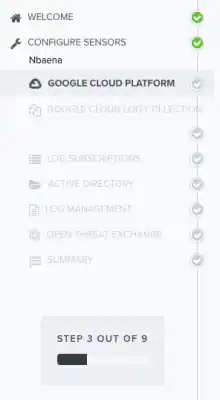
The first time you log in from the Welcome to USM Anywhere web page, the Setup Wizard prompts you to complete the configuration of the first deployed sensor. Thereafter, you can use the Sensors page to configure an additional sensor or to change the configuration options for a deployed sensor. See [Sensors Page Overview](../../user-guide/sensor-management/sensors-navigation) for more information.
) in the Configured column. See [Sensors Page Overview](../../user-guide/sensor-management/sensors-navigation) for more information.
Go to **Data Sources > Sensors**, and then click the sensor name to complete the sensor configuration. See [USM Anywhere Sensor Management](../../user-guide/sensor-management/sensor-management) for more information.
## Configuring the Sensor in the Setup Wizard
The first time you log in from the Welcome to USM Anywhere web page, the Setup Wizard prompts you to complete the configuration of the first deployed sensor. Thereafter, you can use the Sensors page to configure an additional sensor or to change the configuration options for a deployed sensor. See [Sensors Page Overview](../../user-guide/sensor-management/sensors-navigation) for more information.
 The Google Cloud Platform Configuration page provides information about the asset discovery that occurs upon the initial deployment of the USM Anywhere Sensor, summarizing the number of instances, instance types, and regions in your environment.
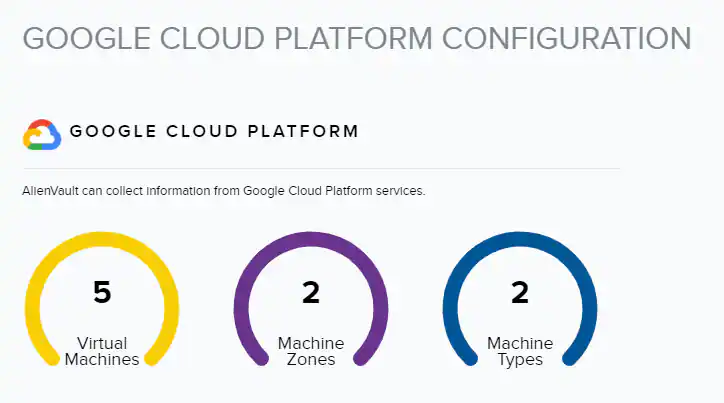 Click **Next** to proceed with the Setup Wizard and complete additional configuration on each page.
USM Anywhere automatically discovers a number of out-of-box logs as long as you have enabled them within your GCP subscription. See [GCP Log Discovery and Collection](gcp-log-collection) in USM Anywhere for more information about these logs and how they function within the GCP environment.
**To enable the out-of-box log collection jobs**
1. Locate the job you want to enable and click
Click **Next** to proceed with the Setup Wizard and complete additional configuration on each page.
USM Anywhere automatically discovers a number of out-of-box logs as long as you have enabled them within your GCP subscription. See [GCP Log Discovery and Collection](gcp-log-collection) in USM Anywhere for more information about these logs and how they function within the GCP environment.
**To enable the out-of-box log collection jobs**
1. Locate the job you want to enable and click  .
This turns the icon green (
.
This turns the icon green ( ).
).
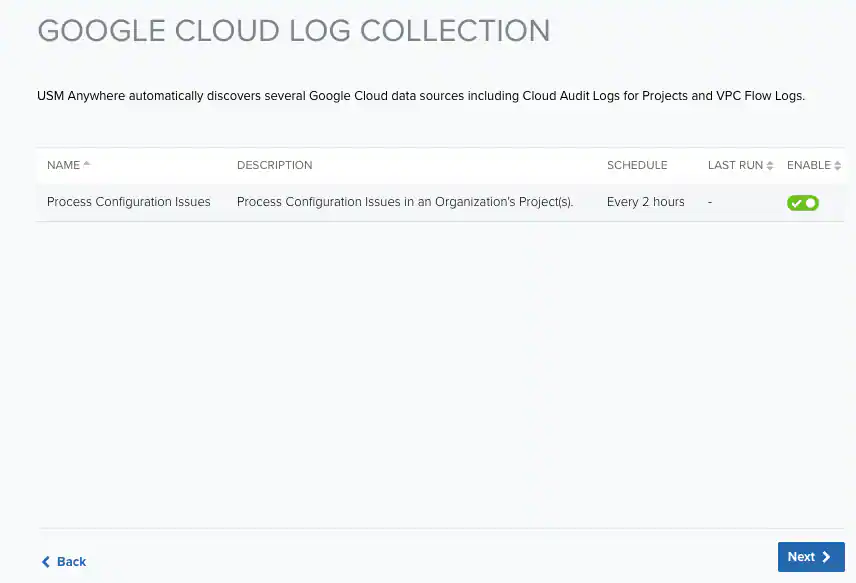 2. Click **Next**.
USM Anywhere uses subscriptions to collect log data from your environment and produce the corresponding events and alarms. See [GCP Log Discovery and Collection](gcp-log-collection) in USM Anywhere for more information about enabling these subscriptions and how they function within the GCP environment.
**To enable the out-of-box log subscriptions**
1. Locate the job you want to enable and click **enable**.
This displays the text as **disable**.
2. Click **Next**.
USM Anywhere uses subscriptions to collect log data from your environment and produce the corresponding events and alarms. See [GCP Log Discovery and Collection](gcp-log-collection) in USM Anywhere for more information about enabling these subscriptions and how they function within the GCP environment.
**To enable the out-of-box log subscriptions**
1. Locate the job you want to enable and click **enable**.
This displays the text as **disable**.
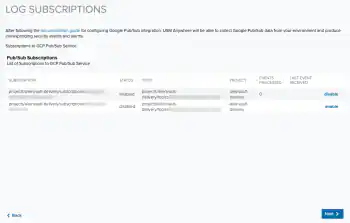 If you don't yet have any subscriptions in your GCP environment, this table will be empty at this step. The steps in [GCP Log Discovery and Collection in USM Anywhere](gcp-log-collection) will create the subscriptions your sensor needs for Google Cloud Pub/Sub.
**Note:** Unless you have previously configured your GCP environment for Cloud Pub/Sub integration (as described in [GCP Log Discovery and Collection in USM Anywhere](gcp-log-collection)), this step will discover any subscriptions that currently exist in your GCP environment. While you may have valid subscriptions already created in your environment for other services, you can only use a subscription created with the configuration described here for Cloud Pub/Sub.
The optional Active Directory (AD) setup page configures USM Anywhere to collect information from your AD account. To monitor Microsoft Windows systems effectively, USM Anywhere needs access to the AD server to collect inventory information.
**Note:** This configuration is only for one AD server. If you want to scan different AD servers, you must create an AD scan job for each of them. See [Scheduling Active Directory Scans from the Job Scheduler Page](../data-source/asset-scan-active-directory) for more information.
LevelBlue recommends that you create a dedicated AD account with membership in the Domain Admins group to be used by USM Anywhere to log in to the Windows systems. You also need to activate Microsoft Windows Remote Management (WinRM) in the domain controller and in all the hosts that you want to scan. You can do this by using a group policy for all the systems in your AD.
**Important:** Before this feature is fully functional, you must configure access to the USM Anywhere Sensor on the AD server. See [Granting Access to Active Directory for USM Anywhere](../setup/granting-access-to-ad-from-usma) for more information.
**To complete the AD access configuration**
1. Provide the AD credentials for USM Anywhere:
* **Active Directory IP Address**: Enter the IP address for the AD server.
* **Username**: Enter your username as admin of the account.
* **Password**: Enter your admin's password.
* **Domain**: Enter the domain for the AD instance.
If you don't yet have any subscriptions in your GCP environment, this table will be empty at this step. The steps in [GCP Log Discovery and Collection in USM Anywhere](gcp-log-collection) will create the subscriptions your sensor needs for Google Cloud Pub/Sub.
**Note:** Unless you have previously configured your GCP environment for Cloud Pub/Sub integration (as described in [GCP Log Discovery and Collection in USM Anywhere](gcp-log-collection)), this step will discover any subscriptions that currently exist in your GCP environment. While you may have valid subscriptions already created in your environment for other services, you can only use a subscription created with the configuration described here for Cloud Pub/Sub.
The optional Active Directory (AD) setup page configures USM Anywhere to collect information from your AD account. To monitor Microsoft Windows systems effectively, USM Anywhere needs access to the AD server to collect inventory information.
**Note:** This configuration is only for one AD server. If you want to scan different AD servers, you must create an AD scan job for each of them. See [Scheduling Active Directory Scans from the Job Scheduler Page](../data-source/asset-scan-active-directory) for more information.
LevelBlue recommends that you create a dedicated AD account with membership in the Domain Admins group to be used by USM Anywhere to log in to the Windows systems. You also need to activate Microsoft Windows Remote Management (WinRM) in the domain controller and in all the hosts that you want to scan. You can do this by using a group policy for all the systems in your AD.
**Important:** Before this feature is fully functional, you must configure access to the USM Anywhere Sensor on the AD server. See [Granting Access to Active Directory for USM Anywhere](../setup/granting-access-to-ad-from-usma) for more information.
**To complete the AD access configuration**
1. Provide the AD credentials for USM Anywhere:
* **Active Directory IP Address**: Enter the IP address for the AD server.
* **Username**: Enter your username as admin of the account.
* **Password**: Enter your admin's password.
* **Domain**: Enter the domain for the AD instance.
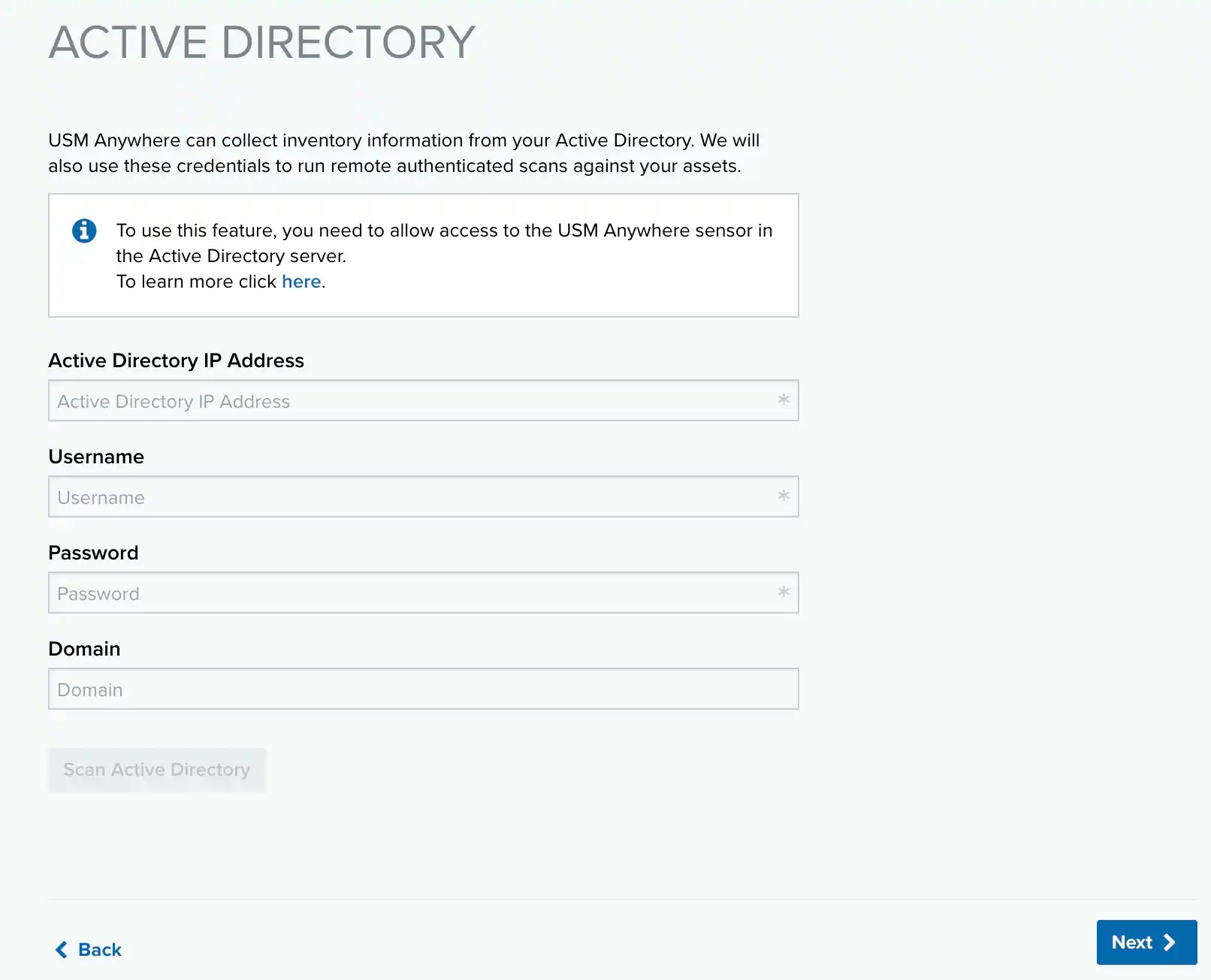 2. Click **Scan Active Directory**.
After a successful launch of the scan, a confirmation dialog box opens.
2. Click **Scan Active Directory**.
After a successful launch of the scan, a confirmation dialog box opens.
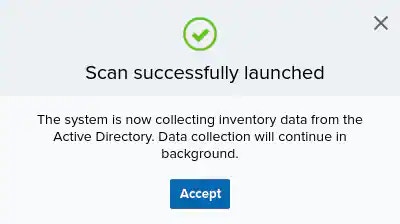 3. Click **Accept**.
The scan continues in the background.
Upon completion, another dialog box opens and provides information about the number of assets USM Anywhere discovered. It also prompts you to decide if you want to scan for hosts and services running in your environment.
3. Click **Accept**.
The scan continues in the background.
Upon completion, another dialog box opens and provides information about the number of assets USM Anywhere discovered. It also prompts you to decide if you want to scan for hosts and services running in your environment.
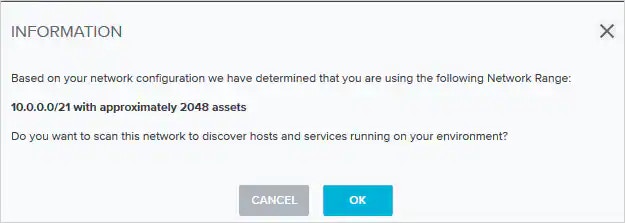 4. (Optional.) If you want to scan for other hosts and services, click **OK**.
5. Click **Next** after the scan ends.
On the Log Management page are syslog port numbers. (These ports are the same for all USM Anywhere Sensors.)
USM Anywhere collects third-party device, system, and application data through syslog over UDP on port 514 and over TCP on ports 601 or 602 by default. It collects Transport Layer Security (TLS)-encrypted data through TCP on ports 6514 or 6515 by default. These ports support the RFC 3164 and RFC 5424 formats. To configure any third-party devices to send data to USM Anywhere, you must provide the IP address and the port number of your USM Anywhere Sensor.
4. (Optional.) If you want to scan for other hosts and services, click **OK**.
5. Click **Next** after the scan ends.
On the Log Management page are syslog port numbers. (These ports are the same for all USM Anywhere Sensors.)
USM Anywhere collects third-party device, system, and application data through syslog over UDP on port 514 and over TCP on ports 601 or 602 by default. It collects Transport Layer Security (TLS)-encrypted data through TCP on ports 6514 or 6515 by default. These ports support the RFC 3164 and RFC 5424 formats. To configure any third-party devices to send data to USM Anywhere, you must provide the IP address and the port number of your USM Anywhere Sensor.
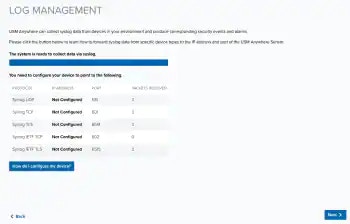 **To enable log collection and configure your log management**
1. Make sure that you have granted the necessary permissions for your OS to allow USM Anywhere to access its logs. You can also integrate a wide variety of data sources to send log data over syslog to the USM Anywhere Sensor.
To learn how to configure your operating systems and supported third-party devices to forward syslog log data, see the following related topics:
* [The Syslog Server Sensor App](../data-source/app-sensor-syslog): Log collection (UDP, TCP, and TLS-encrypted TCP) from rsyslog
* [Collecting Linux System Logs](../setup/collecting-logs-linux): Log collection from a Linux system
* [Collecting Windows System Logs](../setup/collecting-logs-windows): Log collection from a Windows system
* Go to the specific BlueApp in USM Anywhere for instructions about syslog forwarding
**Note:** Because the log scan can take some time, you might not see all of the automatically discovered log sources immediately after deploying the first USM Anywhere Sensor.
2. When you have finished the log collection setup and integrated any needed plugins, verify that the data transfer is occurring.
3. Click **Next** when this step is complete.
LevelBlue Labs™ Open Threat Exchange® (OTX™) is an open information-sharing and analysis network providing users with the ability to collaborate, research, and receive alerts on emerging threats and indicators of compromise (IoCs) such as IP addresses, file hashes, and domains.
You must have an OTX account to receive alerts based on threats identified in OTX. This account is separate from your USM Anywhere account. Go to [The World’s First Truly Open Threat Intelligence Community](https://otx.alienvault.com/) to create an OTX account.
**To enable log collection and configure your log management**
1. Make sure that you have granted the necessary permissions for your OS to allow USM Anywhere to access its logs. You can also integrate a wide variety of data sources to send log data over syslog to the USM Anywhere Sensor.
To learn how to configure your operating systems and supported third-party devices to forward syslog log data, see the following related topics:
* [The Syslog Server Sensor App](../data-source/app-sensor-syslog): Log collection (UDP, TCP, and TLS-encrypted TCP) from rsyslog
* [Collecting Linux System Logs](../setup/collecting-logs-linux): Log collection from a Linux system
* [Collecting Windows System Logs](../setup/collecting-logs-windows): Log collection from a Windows system
* Go to the specific BlueApp in USM Anywhere for instructions about syslog forwarding
**Note:** Because the log scan can take some time, you might not see all of the automatically discovered log sources immediately after deploying the first USM Anywhere Sensor.
2. When you have finished the log collection setup and integrated any needed plugins, verify that the data transfer is occurring.
3. Click **Next** when this step is complete.
LevelBlue Labs™ Open Threat Exchange® (OTX™) is an open information-sharing and analysis network providing users with the ability to collaborate, research, and receive alerts on emerging threats and indicators of compromise (IoCs) such as IP addresses, file hashes, and domains.
You must have an OTX account to receive alerts based on threats identified in OTX. This account is separate from your USM Anywhere account. Go to [The World’s First Truly Open Threat Intelligence Community](https://otx.alienvault.com/) to create an OTX account.
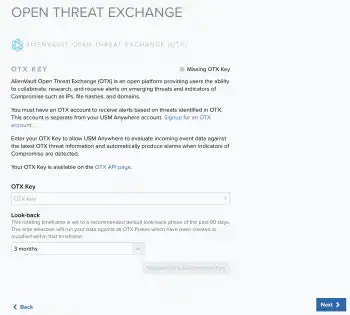 **Note:** If you do not already have an OTX account, click the **Sign up** link. This opens another browser tab or window that displays the OTX signup page. After you confirm your email address, you can log in to OTX and retrieve the unique API key for your account.
See [Open Threat Exchange® and USM Anywhere](../../user-guide/otx/open-threat-exchange) for more information about OTX integration in USM Anywhere.
**To enable USM Anywhere to evaluate event data against the latest OTX intelligence**
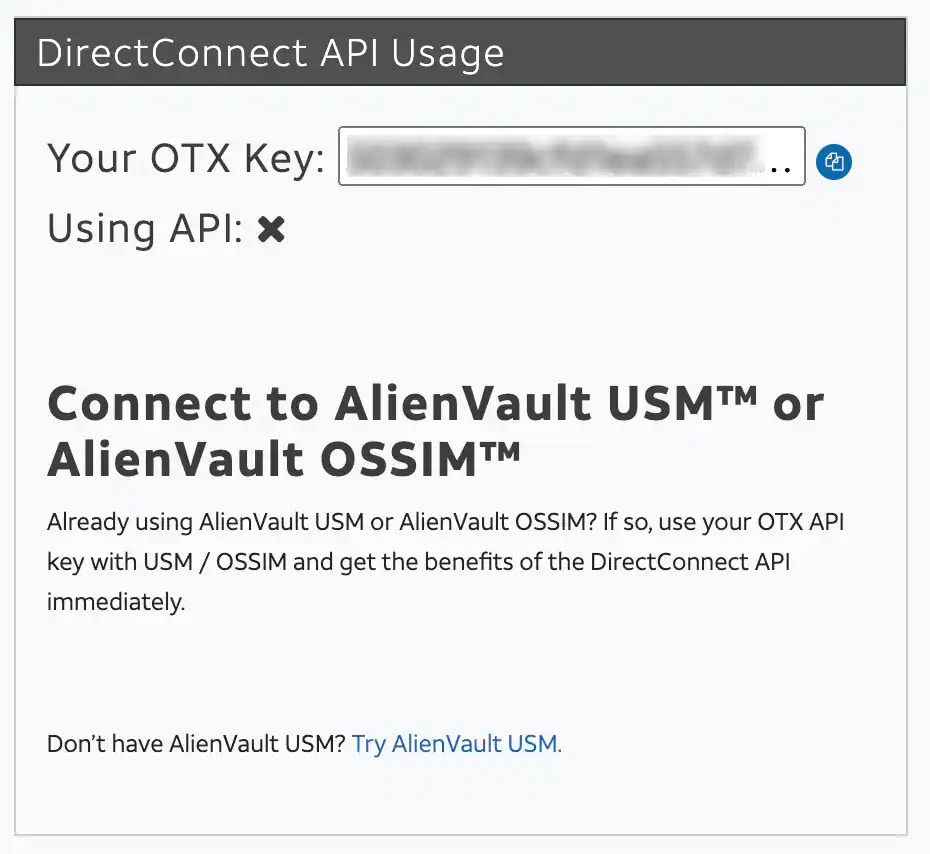
1. Log in to OTX and open the API page ([https://otx.alienvault.com/api](https://otx.alienvault.com/api)).
2. In the DirectConnect API Usage pane, click the
**Note:** If you do not already have an OTX account, click the **Sign up** link. This opens another browser tab or window that displays the OTX signup page. After you confirm your email address, you can log in to OTX and retrieve the unique API key for your account.
See [Open Threat Exchange® and USM Anywhere](../../user-guide/otx/open-threat-exchange) for more information about OTX integration in USM Anywhere.
**To enable USM Anywhere to evaluate event data against the latest OTX intelligence**
1. Log in to OTX and open the API page ([https://otx.alienvault.com/api](https://otx.alienvault.com/api)).
2. In the DirectConnect API Usage pane, click the  icon to copy your unique OTX connection key.
 3. Return to the Open Threat Exchange (OTX) page of the USM Anywhere Sensor Setup Wizard and paste the value in the OTX Key text box.
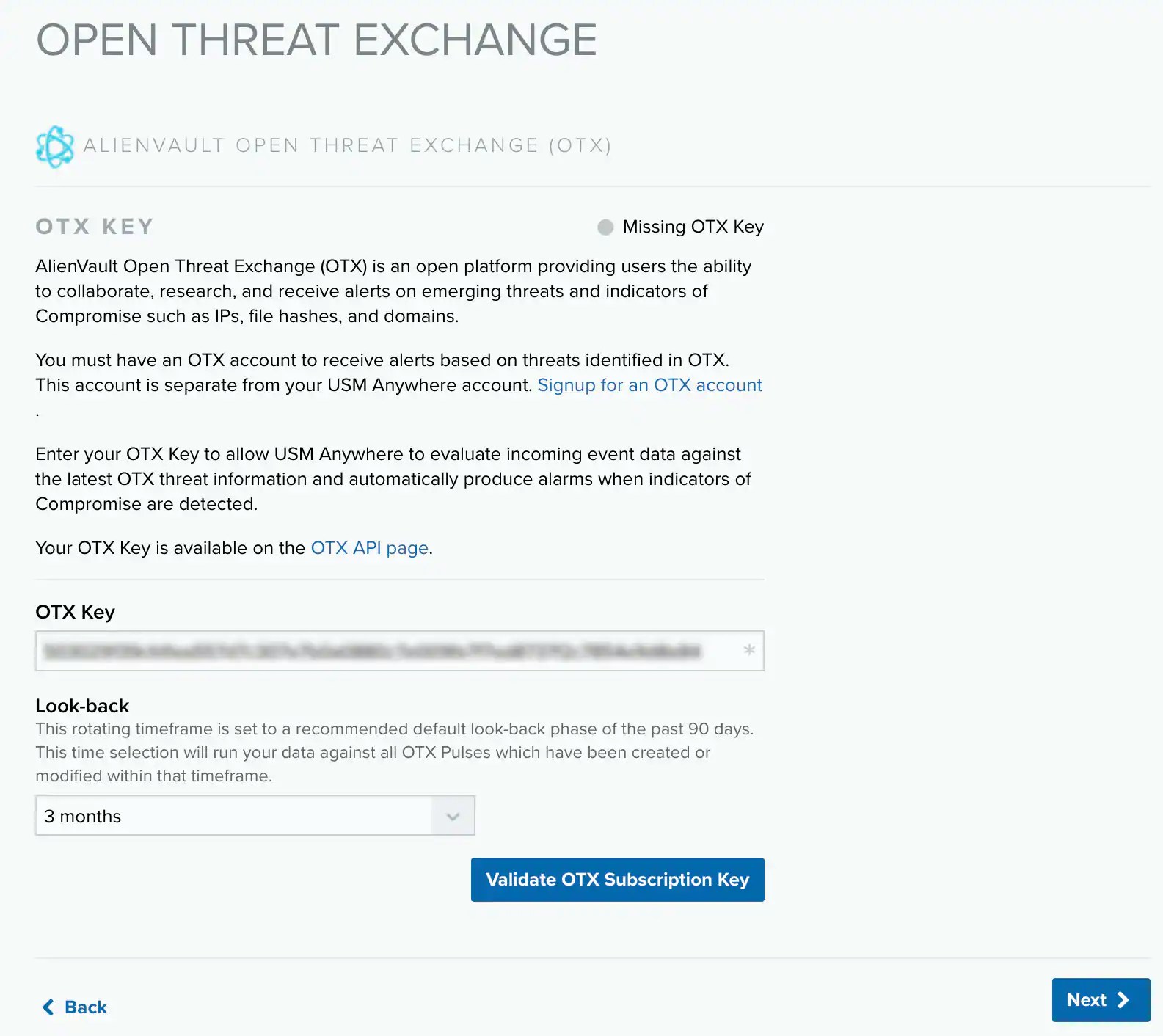 4. Click **Validate OTX Subscription Key**.
With a successful validation of the key, the status at the top of the page changes to "Valid OTX key".
5. Click **Next** when this task is complete.
The Congratulations page summarizes the status of your configuration.
4. Click **Validate OTX Subscription Key**.
With a successful validation of the key, the status at the top of the page changes to "Valid OTX key".
5. Click **Next** when this task is complete.
The Congratulations page summarizes the status of your configuration.
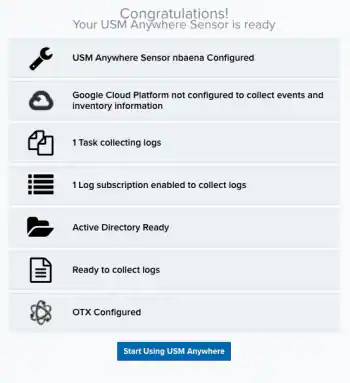 Click **Start Using USM Anywhere**, which takes you to the Overview dashboard.
Now is a great time to run a vulnerability scan. See [Vulnerability Assessment](../../user-guide/vulnerability-assessment/vulnerability-assessment) for detailed information about running a vulnerability scan.
Click **Start Using USM Anywhere**, which takes you to the Overview dashboard.
Now is a great time to run a vulnerability scan. See [Vulnerability Assessment](../../user-guide/vulnerability-assessment/vulnerability-assessment) for detailed information about running a vulnerability scan.