 icon. This will display all of your bookmarked items and provide direct links to each of them.
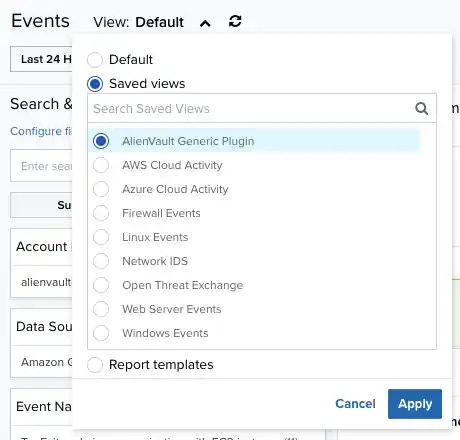 This view works the same as the events list view. On the left you can find the search and filter options. In the upper side of the page, you can see any filters you have applied, and you have the option to create and select different views of the events. The main part of the page is the actual list of events. Each row describes an individual event.
If you want to analyze the data and see the additional columns without having to scroll left and right, you can maximize the screen and hide the filter pane. Click the
This view works the same as the events list view. On the left you can find the search and filter options. In the upper side of the page, you can see any filters you have applied, and you have the option to create and select different views of the events. The main part of the page is the actual list of events. Each row describes an individual event.
If you want to analyze the data and see the additional columns without having to scroll left and right, you can maximize the screen and hide the filter pane. Click the  icon to hide the filter pane. Click the
  icon to expand the filter pane.
The following table lists the fields you see on the page.
**List of the Default Columns in the LevelBlue Generic Data Source**
icon to expand the filter pane.
The following table lists the fields you see on the page.
**List of the Default Columns in the LevelBlue Generic Data Source**
| Column / Field Name | Description |
|---|---|
| Event Name | Name of the event. |
| Time Created | The date and time of the creation of the event. The displayed date depends on your computer's time zone. |
| OTX | Indicate if it is an |
| Reporting Device | The asset that sent the |
| Source Asset |
Hostname or IP address of the |
| Destination Asset |
Hostname or IP address of the host (with the national flag if the country is known) that receives the event. |
| Sensor |
Name of the USM Anywhere Sensor detecting the event. The type of sensor is also displayed below the sensor name. |
| Username | Username associated with the event. |
 icon to access the following options. Your access to these options may vary based on your user role. See [Role-Based Access Control (RBAC) in USM Anywhere](../user-management/rbac) for more information:
* **Assign plugin**: See [Adding BlueApps to an Asset](../asset-management/asset-administration/adding-alienapps-to-assets) for more information.
* **Full Details**: See [Viewing Assets Details](../asset-management/asset-administration/viewing-asset-details) for more information.
* **Configure Asset**: See [Editing Assets](../asset-management/asset-administration/editing-assets) for more information.
* **Delete Asset**: See [Deleting the Assets](../asset-management/asset-administration/deleting-assets) for more information.
* **Assign Credentials**: See [Managing Credentials in USM Anywhere](../vulnerability-assessment/credentials) for more information.
* icon to access the following options. Your access to these options may vary based on your user role. See [Role-Based Access Control (RBAC) in USM Anywhere](../user-management/rbac) for more information:
* **Add to current filter**: Use this option to add the asset name as a search filter. See [Searching Events](searching-events).
* **Look up in OTX**: This option searches the IP address of the source asset in the Open Threat Exchange page. See [Using OTX in USM Anywhere](../otx/using-otx-in-anywhere)
* **Add asset to system**: Use this option to create the asset in the system. See [Adding Assets](../asset-management/asset-administration/adding-assets).
You can configure the view you want for the list of events; see Views for more information.
Click **Generate Report** to open the Configure Report dialog box. See [Create an Events Report](exporting-events) for more details.
The graph above the events list displays the amount of events in a period of time. You can change this period by clicking **Last 24 Hours** filter.
Click the
icon to access the following options. Your access to these options may vary based on your user role. See [Role-Based Access Control (RBAC) in USM Anywhere](../user-management/rbac) for more information:
* **Assign plugin**: See [Adding BlueApps to an Asset](../asset-management/asset-administration/adding-alienapps-to-assets) for more information.
* **Full Details**: See [Viewing Assets Details](../asset-management/asset-administration/viewing-asset-details) for more information.
* **Configure Asset**: See [Editing Assets](../asset-management/asset-administration/editing-assets) for more information.
* **Delete Asset**: See [Deleting the Assets](../asset-management/asset-administration/deleting-assets) for more information.
* **Assign Credentials**: See [Managing Credentials in USM Anywhere](../vulnerability-assessment/credentials) for more information.
* icon to access the following options. Your access to these options may vary based on your user role. See [Role-Based Access Control (RBAC) in USM Anywhere](../user-management/rbac) for more information:
* **Add to current filter**: Use this option to add the asset name as a search filter. See [Searching Events](searching-events).
* **Look up in OTX**: This option searches the IP address of the source asset in the Open Threat Exchange page. See [Using OTX in USM Anywhere](../otx/using-otx-in-anywhere)
* **Add asset to system**: Use this option to create the asset in the system. See [Adding Assets](../asset-management/asset-administration/adding-assets).
You can configure the view you want for the list of events; see Views for more information.
Click **Generate Report** to open the Configure Report dialog box. See [Create an Events Report](exporting-events) for more details.
The graph above the events list displays the amount of events in a period of time. You can change this period by clicking **Last 24 Hours** filter.
Click the  icon to access these options:
* **Actions / User**: Reports USM Anywhere account activity based on specific account users and summarized by Create, Read, Update, and Delete categories.
* **Count / Time**: Provides Reports USM Anywhere account activity based on specific account users and summarized by Create, Read, Update, and Delete categories.
* **Auth / User**: Reports authorization actions.
* **Source Map**: Provides the number of events associated with each country on a global map.
Click the icon to bookmark an item for quick access.
icon. This will display all of your bookmarked items and provide direct links to each of them.
icon to access these options:
* **Actions / User**: Reports USM Anywhere account activity based on specific account users and summarized by Create, Read, Update, and Delete categories.
* **Count / Time**: Provides Reports USM Anywhere account activity based on specific account users and summarized by Create, Read, Update, and Delete categories.
* **Auth / User**: Reports authorization actions.
* **Source Map**: Provides the number of events associated with each country on a global map.
Click the icon to bookmark an item for quick access.
icon. This will display all of your bookmarked items and provide direct links to each of them.
 icon to filter your search by row fields. See [Filtering Events by Row Fields](searching-events) for more information.
You can choose the number of items to display by selecting **20**, **50**, or **100** below the table. You can classify some columns by clicking the icons to the right side of the heading. You can sort the item information in ascending or descending order.
## Configuring Columns
Within the page, you can configure the columns and fields that display in the list view. You can also save your configuration settings for later use.
**To configure your columns**
1. From the LevelBlue Generic Data Source list view, click the
icon to filter your search by row fields. See [Filtering Events by Row Fields](searching-events) for more information.
You can choose the number of items to display by selecting **20**, **50**, or **100** below the table. You can classify some columns by clicking the icons to the right side of the heading. You can sort the item information in ascending or descending order.
## Configuring Columns
Within the page, you can configure the columns and fields that display in the list view. You can also save your configuration settings for later use.
**To configure your columns**
1. From the LevelBlue Generic Data Source list view, click the  icon.
The Manage Columns dialog box opens.
icon.
The Manage Columns dialog box opens.
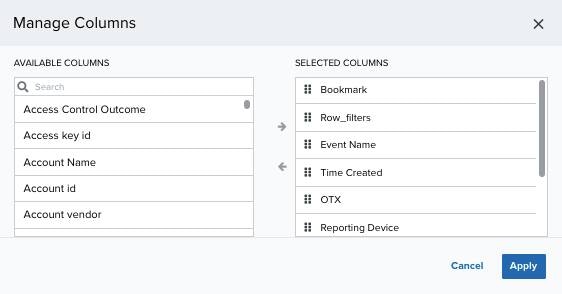 2. Search the columns you want to have in the list view by using the search field.
3. Use the
2. Search the columns you want to have in the list view by using the search field.
3. Use the  and
and  icons to select or deselect from the available columns.
4. You can order the columns by clicking and dragging the column to the desired place.
5. Click **Apply**.
icon.
2. Use the and icons to pass the items from one column to another and select the columns you want to see.
3. Click **Apply**.
4. If you want to delimit the search, select the filters you want to apply.
5. Go to **Save View > Save As**.
The Save Current View dialog box opens.
icons to select or deselect from the available columns.
4. You can order the columns by clicking and dragging the column to the desired place.
5. Click **Apply**.
icon.
2. Use the and icons to pass the items from one column to another and select the columns you want to see.
3. Click **Apply**.
4. If you want to delimit the search, select the filters you want to apply.
5. Go to **Save View > Save As**.
The Save Current View dialog box opens.
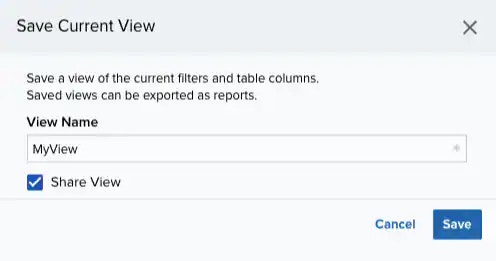 6. Enter a name for the view.
7. (Optional) Select **Share View** if you want to share your view with other users.
8. Click **Save**.
The created view is already selected.
6. Enter a name for the view.
7. (Optional) Select **Share View** if you want to share your view with other users.
8. Click **Save**.
The created view is already selected.
 icon next to its name.
 icon next to the saved view you want to delete.
A Settings Delete dialog box opens to confirm the deletion.
3. Click **Accept**.
icon does not display if the view is selected.
icon next to the saved view you want to delete.
A Settings Delete dialog box opens to confirm the deletion.
3. Click **Accept**.
icon does not display if the view is selected.