

is the processing of the stream to identify important events or patterns of events within large volumes of data. The logic to identify these events is encapsulated in a . The LevelBlue Labs™ Security Research Team creates correlation rules, which associate multiple events from one or more data sources to identify potential security threats. These rules identify patterns associated with . are generated by an explicit call within these rules.
These correlation rules are created by the Security Research Team and you are not able to modify them. However, you can use orchestration rules to modify the way USM Anywhere treats events. See Orchestration Rules for more information.
What Is Correlation?
Correlation is a process performed by the correlation engine in USM Anywhere. It identifies potential security threats by detecting behavior patterns across different types of , which produce disparate yet related events. Correlation links different events, turning data into more useful information. The logs received and processed by USM Anywhere carry important information such as what your users are doing, what data is being accessed, how your system and network are performing, and if there are any security threats or attacks taking place. However, reading logs has these disadvantages:- Logs vary from system to system or even from version to version on the same system.
- Logs have limited perspective because each system sees events from its own perspective.
- Logs are static, fixed points in time without the full context or sequence of related events.
- Make informed decisions on how to respond to security threats
- Validate the effectiveness of existing security controls
- Measure and report compliance
- Detect policy violations
Correlation Rules Structure
This is the structure of correlation rules: Intent — Strategy — Method. The structure uses a three-tiered model for describing an observed behavior:- Intent: The first tier is the “intent” of the behavior. This roughly maps to the “intrusion kill chain” to provide an understanding of the context of the behavior.
- Strategy: The second tier is the strategy the took, used to describe the methodology employed.
- Method: The third tier is the “method” of the behavior, used to describe the details of the particular methodology.
Strategy
The strategy describes the broad-based strategy or behavior that is detected. It is a description of the strategy the malicious user is using to achieve their goal. For example, when trying to exploit a known vulnerability in a web browser, the attacker is launching a “Client-Side Attack - Known Vulnerability”.
Method
The method describes the approach that the actor employs. To further the previous example, the method would provide additional detail on the target of the attack and the vulnerability “Firefox - CVE-2008-4064”.
USM Anywhere Correlation Rules
USM Anywhere provides built-in rules and adds more every week through the LevelBlue Labs™ . Some of these rules are generic, which means that the rule can match data from different data sources. For example, the following rule matches data from all web datasources: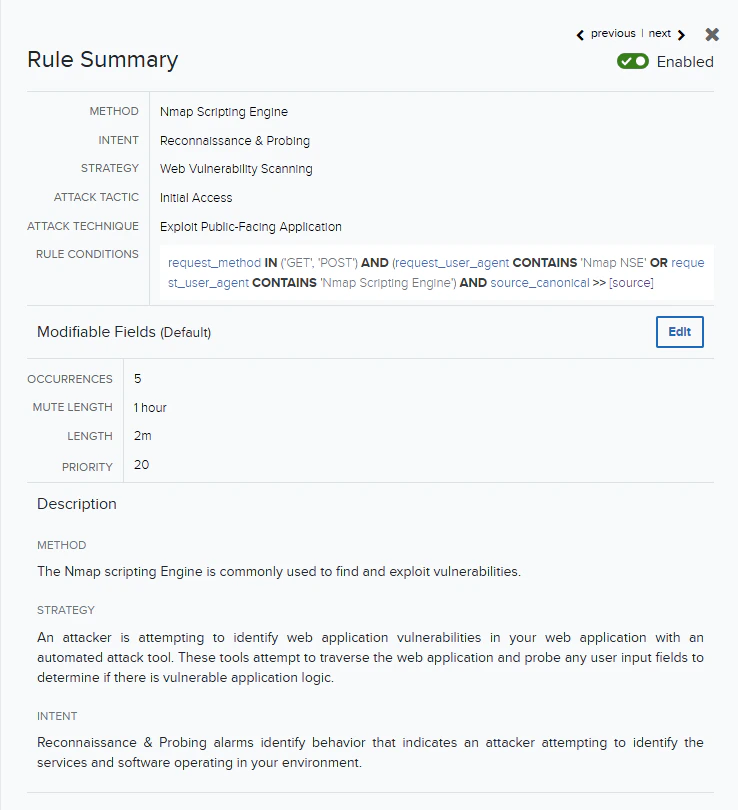
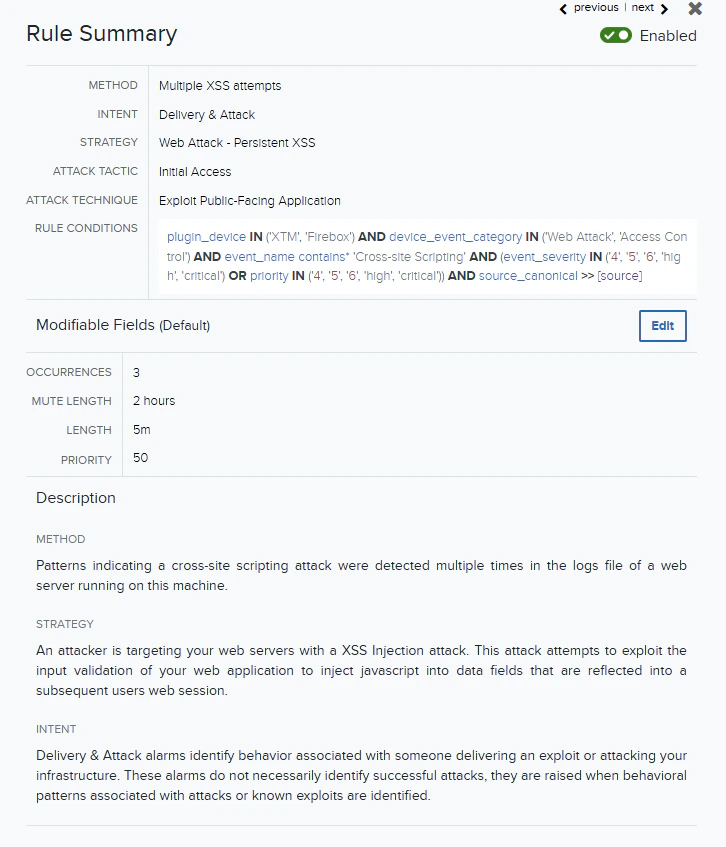
Note: When a more specific rule exists in USM Anywhere, it takes precedence over the generic rule.